
Recap › 2025 Recap: One Year of Live Trading
2025 marked an important milestone for Barudion. It was the first full calendar year in which both our Basic and Pro portfolios were actively traded via the site, allowing us to evaluate the live performance against the S&P 500 (EUR, total return) as a benchmark. While we have done extensive backtesting based on data going back two decades, real-world trading always includes some effects that are not perfectly captured in simulations (such as certain execution effects, trading frictions, suboptimal timing, etc...) that only become fully apparent in live conditions.
As one of the creators of Barudion, I wanted to show "skin in the game" from the start, so all the statistics presented here reflect the actual performance of my personal investment accounts, which have been managed using the Barudion site since mid-January 2025.
The macro-economic year 2025 began under heightened uncertainty. In the first few months of 2025, the U.S. stock market was unsettled and experienced a notable downturn amid uncertainty over aggressive tariff policy and recession fears. Gold surged sharply as a safe-haven asset and continued to perform well throughout the year amid ongoing geopolitical tensions. The US stock market ultimately rebounded, supported by strong corporate earnings and market participants becoming accustomed to Trump's surprising economic interventions. However, this rebound was not as strong for EU investors as it was for US investors, as the Euro appreciated significantly against the US Dollar over the year.
Barudion portfolios entered the year well-positioned with a mixed exposure to gold and stocks. Importantly, the significant allocation to gold acted as a stabilizing factor. This positioning contributed to steady gains even when equity markets struggled in the first months. While our Basic Portfolio (which is always fully invested) only marginally shifted capital from gold to stocks over the year, the Pro Portfolio (which adapts its cash position dynamically) increased its overall exposure significantly after the tariff-induced volatility subsided.
The consistent allocation to gold helped mitigate downside risk in early 2025 while still allowing participation in equity recoveries later in the year.
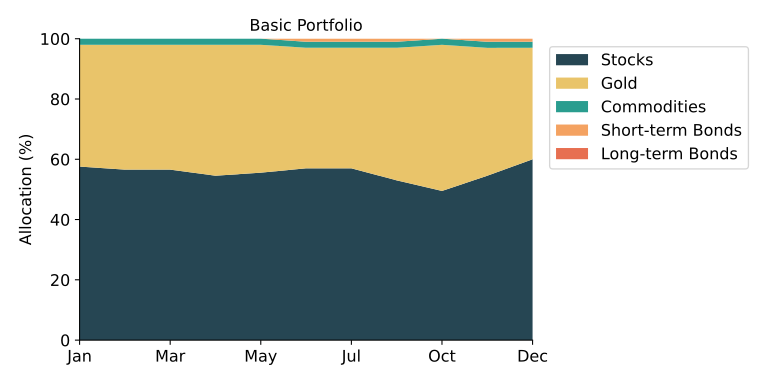
| Month | Stocks | Gold | Commodities | Short-term Bonds | Long-term Bonds |
|---|---|---|---|---|---|
| Jan | 57% | 40% | 2% | 0% | 0% |
| Feb | 56% | 41% | 2% | 0% | 0% |
| Mar | 56% | 41% | 2% | 0% | 0% |
| Apr | 54% | 43% | 2% | 0% | 0% |
| May | 55% | 42% | 2% | 0% | 0% |
| Jun | 57% | 40% | 2% | 1% | 0% |
| Jul | 57% | 40% | 2% | 1% | 0% |
| Aug | 53% | 44% | 2% | 1% | 0% |
| Oct | 49% | 48% | 2% | 0% | 0% |
| Nov | 54% | 42% | 2% | 1% | 0% |
| Dec | 60% | 37% | 2% | 1% | 0% |
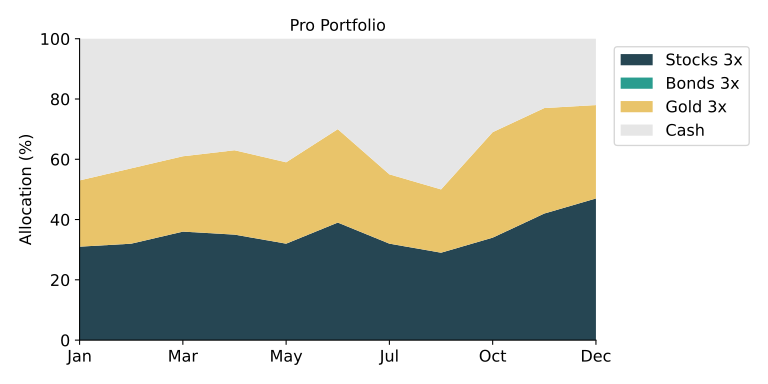
| Month | Stocks 3x | Bonds 3x | Gold 3x |
|---|---|---|---|
| Jan | 31% | 0% | 22% |
| Feb | 32% | 0% | 25% |
| Mar | 36% | 0% | 25% |
| Apr | 35% | 0% | 28% |
| May | 32% | 0% | 27% |
| Jun | 39% | 0% | 31% |
| Jul | 32% | 0% | 23% |
| Aug | 29% | 0% | 21% |
| Oct | 34% | 0% | 35% |
| Nov | 42% | 0% | 35% |
| Dec | 47% | 0% | 31% |
The Pro Portfolio is designed for maximizing returns while maintaining a stable risk profile through dynamic adaptation. This combination of capital-efficient leverage and dynamic risk control allowed the Pro Portfolio to achieve very strong performance in 2025, outperforming the S&P 500 by over 30%!
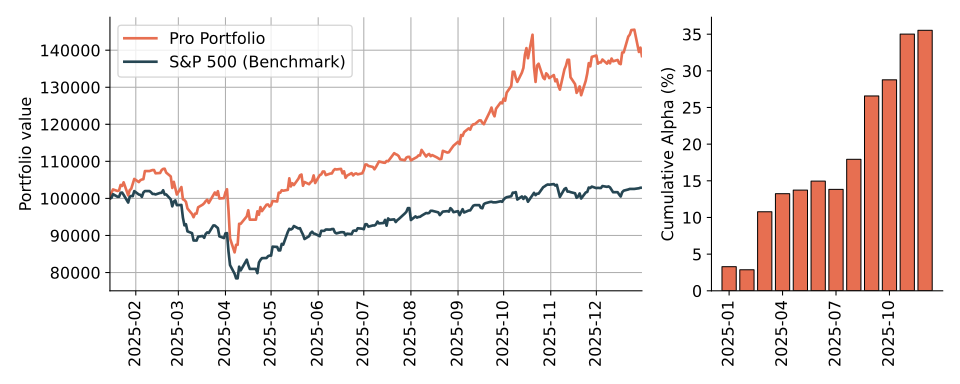
The Pro Portfolio outperformed the S&P 500 early in the year during stressed markets conditions by limiting the downside participation, and then again later in the year by participating in the gold rally.
Cumulative Alpha: +35.5%
In 2025, the Pro Portfolio delivered a cumulative alpha of +35.5% against the S&P 500 (EUR, total return), which is an outstanding result for a strategy that maintains a similar risk profile to the stock market. This means that the Pro Portfolio generated a return that was 35.5 percentage points higher than the S&P 500 over the course of the year, after accounting for all costs and fees. This was mostly driven by the significant allocation to gold that our algorithm suggested early on.
Monthly Hit Rate: 75%
In 3 out of 4 months in 2025, the Pro Portfolio outperformed the S&P 500, demonstrating consistent alpha generation throughout the year. This metric shows the strategy's ability to diversify well, since the monthly update frequency is rather slow, so the portfolio must be positioned to handle different short-term market regimes effectively.
Max Drawdown: -20.9% The Pro Portfolio experienced its maximum drawdown in 2025 in early April, at the height of the tariff induced volatility. Despite using leveraged products, however, this drawdown was slightly smaller compared to the S&P 500's drawdown of -23.3% during the same period, demonstrating the strategy's ability to attain a risk profile that is comparable to the stock market, while still generating significant alpha.
Information Ratio: 2.77 The information ratio indicates that the Pro Portfolio delivered a very high level of risk-adjusted returns relative to the S&P 500. A value > 2 is an excellent result, and higher than the expected long-term average for the Pro Portfolio. This shows that the balance of diversification and capital-efficient leverage worked very well in 2025, allowing the strategy to capture significant upside while controlling downside risk effectively.
During years of stunning performance one is tempted not to question the results in any way, but it is nonetheless important to compare the live performance with the expectations set by our backtests. In the end, the backtests are what we used to design the strategy, and if the live performance deviates significantly from the backtest results, this would be a sign that some important effect is not being captured in our simulations. Furthermore, I traded the Pro Portfolio via Smartbroker+, so a direct comparison with the backtest results will show whether execution effects and trading frictions are significant in practice.
The chart below shows that the live performance of the Pro Portfolio in my own account matches the weekly simulation results only if we assume a rather high effective fee of 4% on all trading volume. Liquid ETFs can usually be traded with a fee of around 0.1% per trade. One has to keep in mind that the effective fee of 4% further includes capital gains taxes that were automatically deducted from the account when rebalancing that portfolio, as well as tracking errors on my side, as I did not always update on the exact date that the model portfolio suggested, and even missed one monthly update completely.
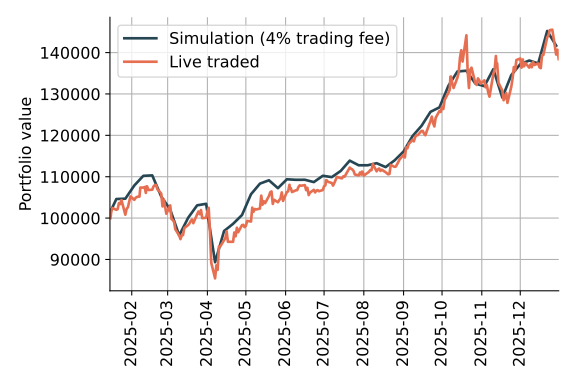
This analysis suggests that execution matters if one wants to maximize the returns of the Pro portfolio. Using market orders on rather illiquid, leveraged ETFs, and paying capital gains tax on every rebalancing date can eat into the returns of the strategy quite significantly. For a convenient solution to this problem, keep on reading...
In January 2026, we partnered up with the wealth management firm Fortezza Finanz AG and Vontobel to issue an exchange-traded, strategic certificate that mirrors the systematic strategy underlying the Pro Portfolio. The certificate allows investors to gain exposure to the Pro Portfolio's systematic strategy without the need to replicate the portfolio themselves, while still maintaining the same underlying logic and risk profile. It can be bought via most european brokers, and offers full tax efficiency, as one only pays capital gains tax when selling the certificate again, but not when the assets within the certificate are rebalanced!
The certificate is directly based on our Pro Portfolio, so it uses predominantly leveraged derivatives to gain exposure to stock indices, bonds, and gold. By using Vontobel's own suite of derivatives contracts, the costs of rebalancing are greatly reduced. The certificate further includes a position in broad commodities. We will gradually develop this certificate further, enabling investors to always have exposure to our latest market models.
Key details of the certificate include:
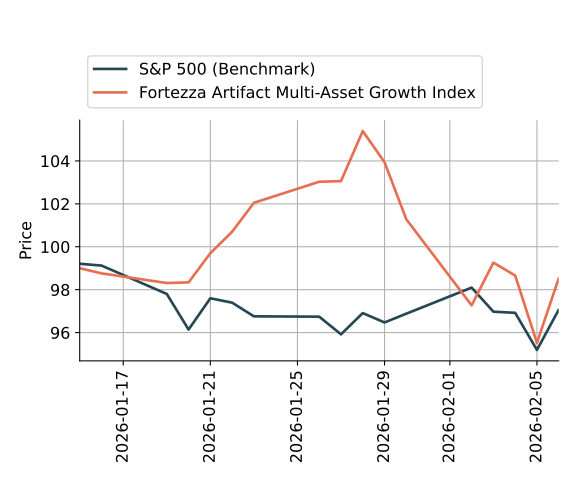
The certificate started actively trading on January 15th 2026, which turned out to be a very volatile start, especially for the gold market (including the worst day for gold in 46 years). However, the use of capital-efficient derivatives inside the certificate in combination with our dynamic risk management allowed the certificate to trade near or above the S&P 500 during its short trading history so far, see the chart below:
The Basic Portfolio is designed to replicate the returns of the S&P 500 in the long-term, while providing a superior risk profile in the short-term, limiting volatility and drawdowns for the risk-aware investor who values stability. In contrast to the Pro Portfolio, the Basic Portfolio does not use leveraged ETFs, diversifies across short-term and long-term government bonds, and adds a broad commodities position (which we have adopted for the strategic certificate as well). In 2025, the Basic Portfolio not only matched the performance of the S&P 500, but actually outperformed it by a significant margin, with a cumulative alpha of +13.9%.
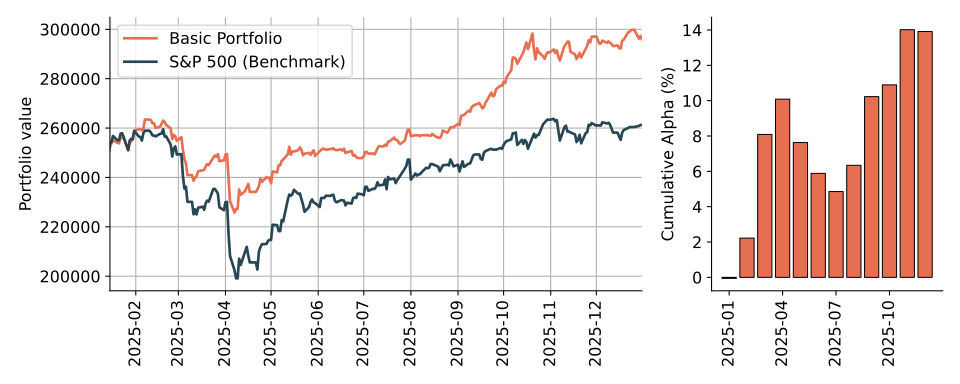
The Basic Portfolio not only demonstrated its intended purpose in 2025, but further provided substantial excess returns, while still limiting downside risk.
As the Basic Portfolio does not use leveraged ETFs, it is not designed to outperform the S&P 500 in terms of raw returns, but rather to provide a superior risk-adjusted return. The fact that it achieved a cumulative alpha of +13.9% in 2025 is a very strong result, and shows that the strategy's focus on diversification and risk management paid off during a volatile year. The Basic Portfolio's lower drawdown compared to the S&P 500 further confirms its role as a more stable investment option for risk-aware investors.
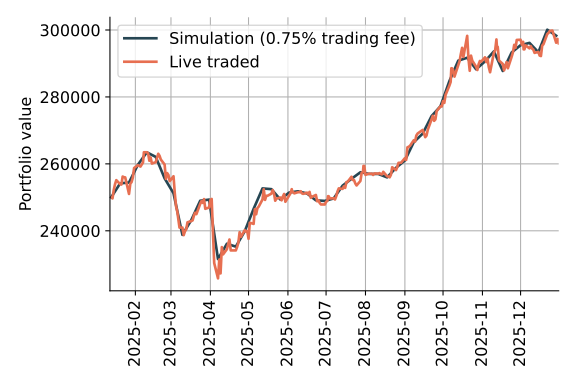
Compared to the Pro Portfolio, we expect that effective trading costs for the Basic Portfolio are much lower, as it only trades ETFs with very high liquidity. The chart below shows that the live performance of the Basic Portfolio in my own account matches the weekly simulation results very well, even if we assume a low effective fee of 0.75% on all trading volume (compared to 4.0% for the Pro Portfolio). This effective fee includes price spreads, taxes that were deducted when rebalancing, and tracking errors due to me trading later than the system suggested.
Below you can easily compare the month-by-month returns of the S&P 500, the Basic Portfolio, and the Pro Portfolio in 2025. The Pro Portfolio outperformed the S&P 500 in 9 out of 12 months, while the Basic Portfolio outperformed in 7 out of 12 months. Both portfolios showed their intended purpose in 2025, with the Pro Portfolio providing significant excess returns during volatile market conditions, and the Basic Portfolio providing stable alpha while limiting downside risk.
Note that I started trading the Basic and Pro Portfolio a few days apart, so the January return for the S&P 500 may not be the perfectly accurate comparison for both Basic and Pro Portfolio.
| Jan | Feb | Mar | Apr | May | Jun | Jul | Aug | Sep | Oct | Nov | Dec | 2025 | |
|---|---|---|---|---|---|---|---|---|---|---|---|---|---|
| S&P 500 | 1.96 | -3.71 | -9.05 | -5.30 | 6.93 | 1.54 | 6.05 | -1.11 | 2.90 | 4.66 | -0.50 | -0.29 | 2.89 |
| Basic | 3.50 | -1.51 | -3.10 | -2.84 | 3.64 | -0.33 | 4.65 | 0.37 | 6.45 | 4.83 | 2.24 | -0.34 | 18.41 |
| Pro | 5.25 | -4.00 | -0.96 | -2.27 | 6.49 | 2.52 | 4.15 | 2.71 | 10.01 | 5.43 | 4.32 | 0.16 | 38.42 |
In summary, the live trading of Barudion's Basic and Pro Portfolios in 2025 demonstrated the effectiveness of our systematic, data-driven approach to portfolio management. It further showed further potential for cost optimization that we have recently implemented in our strategic certificate. We are excited to continue refining our strategies and sharing our insights with the Barudion community over the coming months and years! Stay tuned!